The best, worst and average times for an alarm are all important. Cryonics Monitoring improves on the worst time by over 80%, coming in at only 2 hours.
We develop custom solutions for the unique needs of cryonics. We have over 4 years experience in research and development of cryonics monitoring solutions.
We also publish reviews of other monitoring options, whether they be off-the-shelf or custom.
Our team members are experienced in their technical domains and have a longstanding interest in cryonics.
We work on contract to develop custom solutions for the unique needs of cryonics. We are leaders in this domain of biotech, with over 4 years experience in research and development of cryonics monitoring solutions.
We also provide expert reviews of other monitoring options, whether they be off-the-shelf or custom.
Our team members are experienced in their technical domains and have a longstanding interest in cryonics.



Cryonics Monitoring was founded by Nikki Olson for the purpose of research and development of cryonics monitoring systems. Nikki started working on cryonics monitoring solutions in late 2020 and developed exploratory prototypes for consumer devices such as the Apple Watch, Fitbit, and Android Watches (WearOS).
View ResearchView ReviewsFrom September 2022 to May 2023, she developed a more complete monitoring system for the Fitbit Sense with software developer Philipp Bartels, who created the system's Web UI component. Philipp also contributed research on ballistocardiography (BCG) sensor technology and had editorial involvement in the publishing of the organization's research, review and media content.
When the Fitbit Sense was discontinued in late spring 2023, the team shifted to develop a custom system tailored for cryonics monitoring. Nikki, Jordan, and Michael currently work enthusiastically on developing a custom smart ring for cryonics.
Nikki is a field expert in the challenges of mobile app development in the context of life monitoring. She has fully developed and maintained multiple life monitoring applications in the industry, including with wearable integration. Our team continues to develop and maintain custom mobile and off-the-shelf solutions and are available for future hire.
View DevelopmentIn spring 2023, after several years and multiple prototypes using off-the-shelf wearables, we decided to develop custom hardware for cryonics monitoring. We expanded our team to include two hardware engineers in Ukraine and began an ambitious project to build a smart ring entirely from scratch. We completed our first proof-of-concept circuit board in the fall of 2023 and concluded that, while challenging, our combined skill set would allow us to achieve a production-quality smart ring for cryonics.
View Development HistoryOne of the earliest insights from our research into cryonics monitoring was that pulse detection using light-based sensors (PPG) is unreliable for confirming the absence of a pulse. The signal noise and filtering in such sensors make it nearly impossible to distinguish a true zero reading from data dropout with high accuracy. In testing, for example, the Google Pixel Watch 3 detected only 69% of no-pulse events — you can read more about that here.
For this reason, our smart ring focuses primarily on detecting the absence of hand motion over time, a far more robust and unambiguous indicator for cryonics applications.
A key differentiator of our smart ring is the integration of LoRa (Long Range) communication, a feature not found in any other smart ring on the market.
While most wearables rely solely on Bluetooth Low Energy (BLE), LoRa provides a much greater communication range—currently up to 70 feet indoors, with ongoing improvements expected to extend this to over 100 feet. BLE signals operate at higher frequencies (typically 2.4 GHz), which are easily absorbed or reflected by walls, furniture, and the human body, leading to rapid signal degradation indoors.
LoRa, by contrast, uses sub-GHz frequencies and narrowband modulation, allowing it to maintain reliable transmission through obstacles and over longer distances.
This makes LoRa far better suited for a ring for cryonics monitoring, where robust communication must be maintained even in complex indoor environments or across multiple rooms.
By combining LoRa with BLE, the ring ensures both low-power local connectivity and long-range reliability, creating a communication architecture uniquely capable of supporting real-world biostasis monitoring needs.
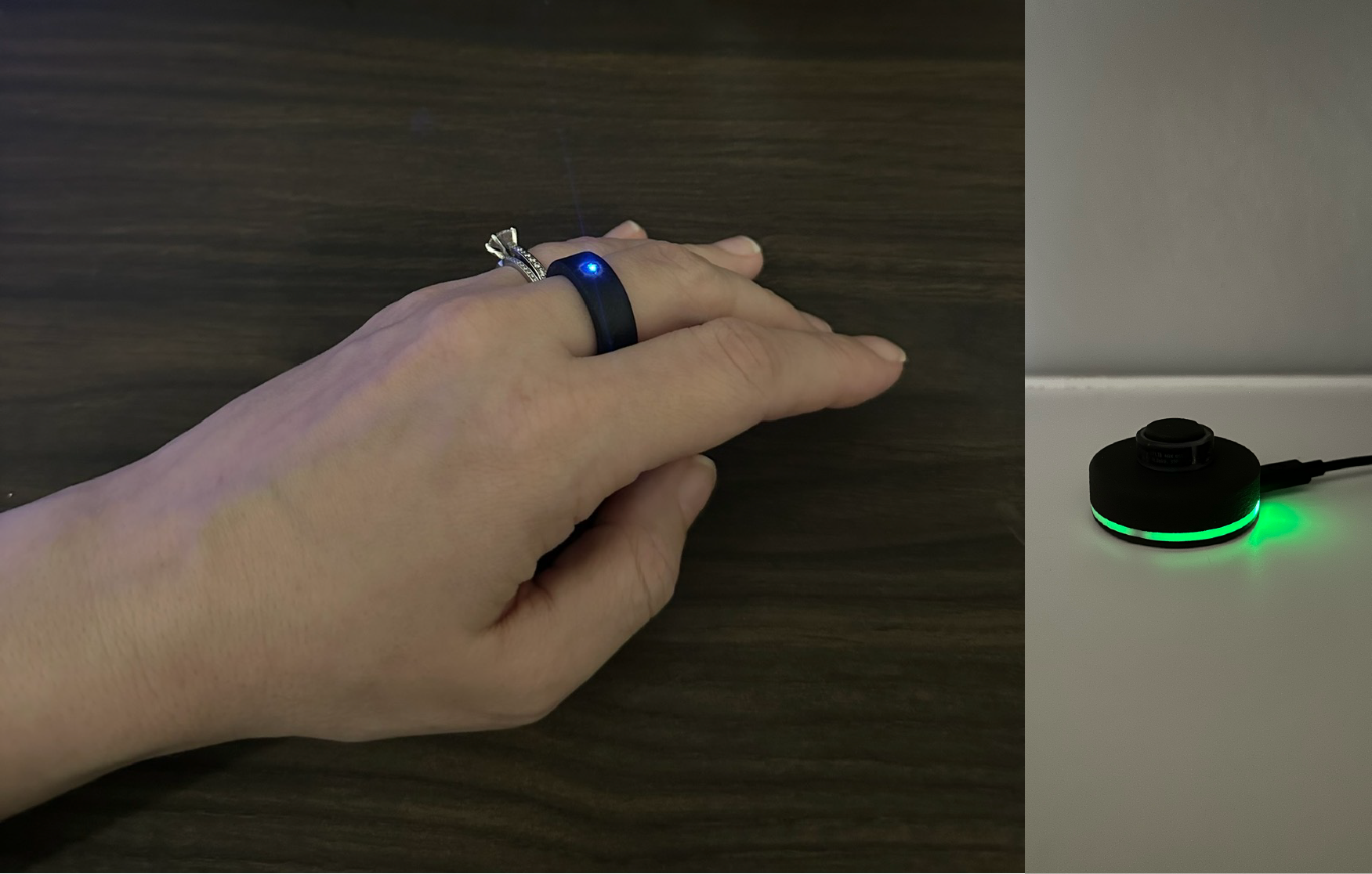
In December 2024, our first fully assembled smart ring was completed, featuring all core components integrated into a compact, functional design. The ring includes wireless charging, LoRa and Bluetooth connectivity, an optical sensor for finger detection, and an accelerometer for motion monitoring — establishing the foundation for a fully autonomous cryonics monitoring device.

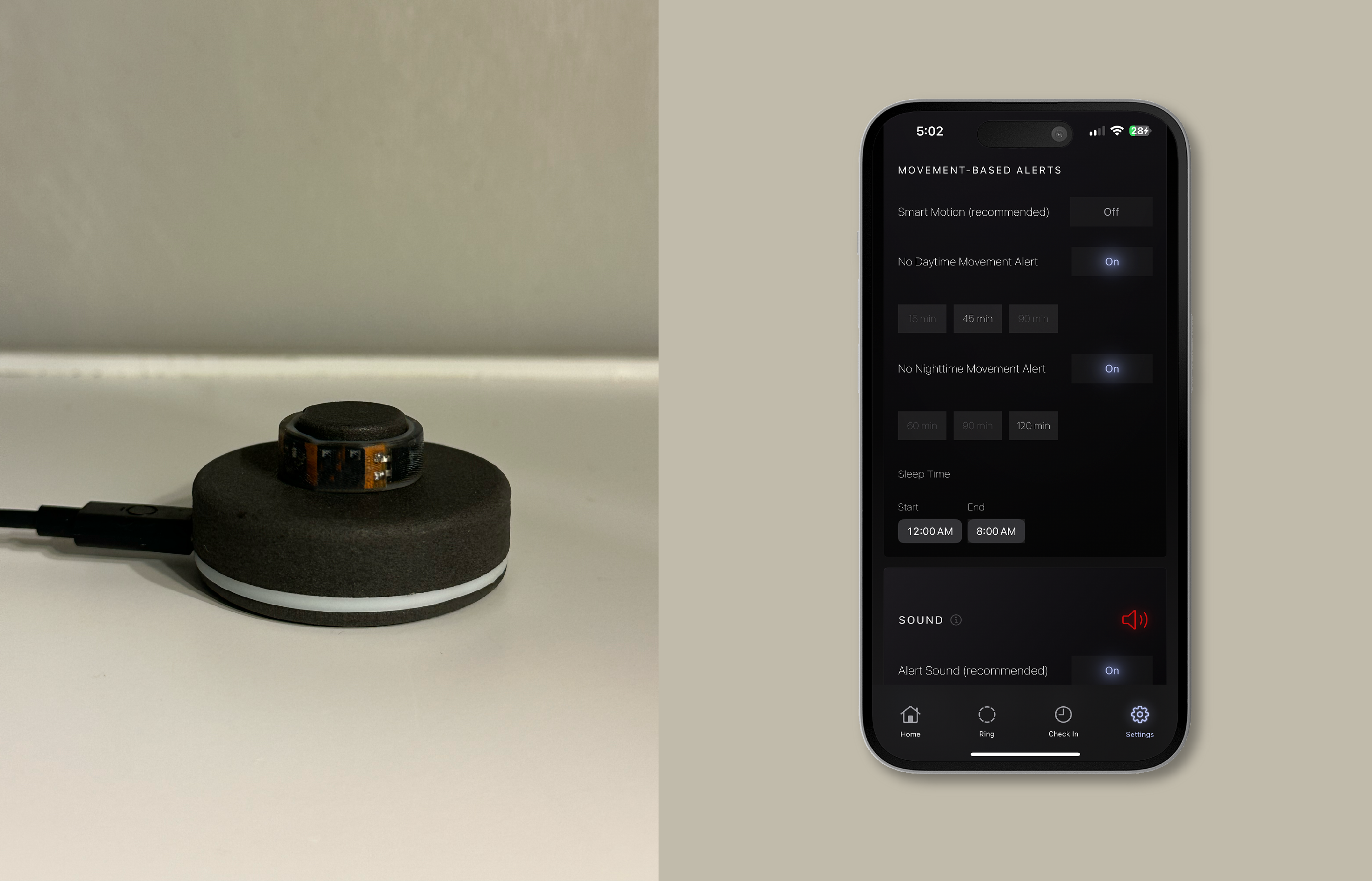
The companion mobile app enables users to add emergency contacts, customize alert messages, and set personalized alarm thresholds based on their preferences or monitoring needs. Through the app, users can define exactly who is notified and under what conditions, ensuring that responses are timely and appropriate. This flexibility allows the system to adapt to individual circumstances while maintaining reliability in critical situations.

After resolving issues discovered in internal testing, we moved into the next phase of development in August 2025.
During internal testing, we resolved several key issues — most notably challenges with the wireless charging component. The ring now charges in about two hours and delivers over 48 hours of battery life. All core components are in place, and the ring’s thickness is now nearly identical to the Oura Ring, the industry leader in smart wearables. The circuit board is feature-complete, requiring only minor revisions to improve LoRa range. Upcoming refinements will focus on streamlining assembly and materials to achieve a waterproof, production-quality finish.


Wireless Charging: Fully functional; 2-hour charge time
Battery Life: Over 48 hours per charge
Connectivity: LoRa and Bluetooth
Sensors:
-Accelerometer for motion detection (primary life indicator)
-Optical sensor for finger detection
Core Function:
Detects absence of hand motion over time to determine potential loss of life
Hardware:
Feature-complete circuit boardMinor revisions planned to improve LoRa range
Physical Design:
Thickness nearly identical to the Oura Ring (industry benchmark)
All core components integrated into compact, functional design
Build Quality:
Upcoming improvements to materials and assembly for a waterproof, production-quality finish
Companion App (iOS and Android):
Add emergency contacts
Customize alert messages
Adjust alarm thresholds
Join our mailing list for updates on important news in this space!